It was a typical sultry summer evening in Washington DC. Dressed in a heavy silk hijab accented by a scarf, I was already glistening with little beads of sweat forming behind my ears. If my body felt thirst, then my mind was definitely preoccupied with other matters during Ramadan in 2013 – now ten years ago.
Is the sweat screwing up my face? Where will I pray? I’ve got less than 30 seconds – how can I say it quickly? Will he remember me? There aren’t that many people he probably meets with a hijab and a cane…
“Is my face okay?” I asked my friend Michelle, who was dressed in equally elegant attire.
“You look amazing!” she reassured me, then squealed, “OH MY GOD! I can’t believe my handwriting is going to be read by THE PRESIDENT!!! What if he can’t read it? What if it’s not legible enough? Don’t you want to type it – maybe there’s a way for it to come out in print?”
“Listen, don’t worry. We need to hurry, and I don’t have a way to type on a notecard right now or get it printed, so just write as best you can. I’m sure he’ll be able to read it,” I said, handing her the blank notecard. From my days at the U.S. Senate, I had remembered a trick; if you want someone to remember an important point, put it on a notecard that they can place in their pocket. When they’re cleaning out that pocket, they’ll read your notecard at least once. If important enough, they might hold on to that notecard and look at it again.
Now I was going to test this, obsessed about whether President Barack Obama would remember this one point from our forthcoming exchange, which I expected would occur at the 2013 White House Iftar. Michelle started writing neatly in marker, then piped up, “This is so cool! I’ve never been to a White House Hanukkah, and before that, I’m going to a White House Iftar! Thank you so much!”
Michelle, my friend who happens to be Jewish, was my “plus one” that evening, and I couldn’t have been more delighted that she was by my side. We had connected as two young associates at a bustling Washington DC law firm. As people who observe Kosher and Halal dietary rules, we quickly figured out that we often couldn’t eat the same things and needed to find alternatives – often together. We discovered we loved the same things – cheese, mushrooms, chocolate, choral music, politics and political satire, our phones, and so much more.
Our friendship, which began over food, had deepened when we both shared a meal after watching the 2009 Presidential Inauguration together. In the icy chill of a DC winter, we had sung in the crowd in the bleachers waiting for the Presidential parade on Pennsylvania and 15th Streets. Neither of us had imagined then that we’d be the odd couple at a White House Iftar a few years later.
When I had received the invitation to the White House, I asked Michelle to join me because, in addition to wanting her to share this experience with me, I knew she would be a terrific companion. Michelle had always seen me as me – just Mariyam. The cane and hijab – the pragmatic manifestations of blindness and my faith – have remained an ordinary part of our friendship. She was glad to assist me in the logistical aspects of navigating an important public event, and was at ease knowing that I would be happy to strike up a conversation with any political or public figure, taking the weight off her shoulders in case she felt tongue-tied in the moment. (Michelle is not one to be tongue-tied as a formidable lawyer, but she is admittedly more introverted than me.)
As we arrived at the White House, Michelle admired the drapes and décor in the various rooms of the East Wing, describing to me the finer details of the Blue Room, in which I prayed magrib (evening prayers). Shortly thereafter, in the dining room, White House staff holding ornate trays of fancy dates welcomed us and ushered us to our assigned table. We exchanged social niceties with the First Lady’s Chief of Staff, the Iraqi Ambassador to the United States, and other notables. Michelle whispered, “Mariyam, it’s real Presidential china,” and started to describe its intricate pattern to me.
I tried to pay attention but was too consumed with the notecard and the message on it. The words I had rehearsed echoed loudly in my head, drowning out the crowd’s roar as the President entered, greeted us all in unison, and eloquently delivered his address.
/arc-anglerfish-arc2-prod-dmn.s3.amazonaws.com/public/TBBY5JZJKA7QPXQCQFYSAYDMKU.jpg)
Soon, dinner was over, and the President was coming around from table to table to meet with us and take photos.
“He’s coming,” Michelle hissed quietly, unable to contain her excitement. And then, for the second time, I met the President.
“Oh hi,” he said, a pro at pretending to remember people he might have seen before somewhere. I ran through my key points, handed him the notecard as a takeaway from our exchange, and asked how to follow up.
“Thanks for what you’re doing. My staff will follow up with you. Now let’s take the photo!” The President nudged me slightly to position me for our table’s photo.
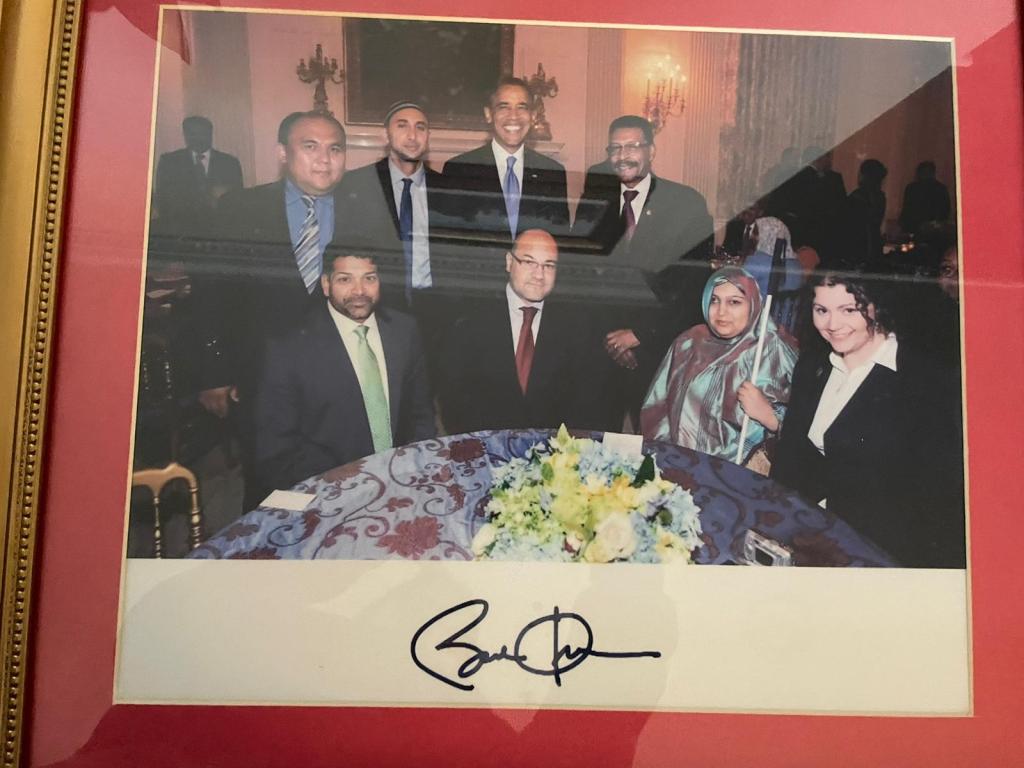
As the President moved on with his photographer, I was a little disappointed at his tepid response. I was still processing our exchange when Michelle clutched me, starstruck. “Oh my God! My handwriting was in the President’s hands! He read my handwriting!”
“He did?!” I beamed, relieved. I was excited he actually read the notecard and kept it, and slightly more thrilled that my friend was gushing at what she had done. It had been a team effort all the way. After the Iftar, Michelle and I decided we needed more chocolate, and found our way to an open restaurant to debrief, chat, laugh, and eat!
A decade later, what I had messaged on the notecard about one specific action from the President to help counter sectarianism through inclusion still remains a work in progress, and that work will continue. But when Michelle and I reminisce about that Iftar, we still laugh – remembering her reaction to the notecard, remembering my fixation with the message and inattentiveness at the décor, remembering the gloriously good time we had before, during, and after the event together, and remembering the amazement of some that a blind hijabi brought her Jewish friend to the White House Iftar! My friend still thanks me for that evening, and I still thank her.
So, in the spirit of Passover, Ramadan, Easter, and all other religious and cultural holidays, bring someone different or new into your world, your experience, your evening – and ask them if you can be a part of theirs. Decades later, it will become a memory you both treasure.
Talk to you next week!


 The Blind Hijabi
Leave a comment