With my birthday month coming to an end, so does this miniseries. Traveling down memory lane has been a fun yet enlightening experience for me, and I’m so glad that you, my readers, got to go on this journey with me.
I hope you’re ready for the last few lessons I have to share. Let’s go!
Tip 5: Our food’s not gross, it’s just different.
Food for me is one of the top pleasures in life, but as a child I found it could also serve as a way to set me apart from other kids at school as I tried to make my way in our new country. I didn’t fully understand back then that the food I was used to in India wasn’t weird or gross; it was just different.
In India, I had loved green chutney sandwiches filled with cucumbers, potatoes and a slice of tomato. My mom helpfully started giving me my favorite sandwiches for lunch as I rejoined the second grade in my new school.
The reaction there was, of course, quite unexpected. “EW!!! You’re eating green slime! What’s that on your bread!? That looks so weird…”
This explosion of disgust often erupted as I gingerly opened my Ziplock sandwich bag, my classmates staring at my food from home as they relished their pizza, hamburgers, cookies, brownies and other delights. Suddenly I found myself repulsed by my favorite lunch.
I didn’t know it at seven-years-old, but there’s actually a name now for what I experienced in the cafeteria—the lunchbox moment.
And like a lot of other immigrant kids who’ve had lunchbox moments, I took steps to fit in. I negotiated which days I could buy lunch at school with my parents, who were concerned about the things I couldn’t eat, like pepperoni pizza. Over time, and given the limits of our financial resources, I relented and started taking lunch from home more regularly again. But this time, I asked mom to make me more “American” lunches, like a turkey sandwich or a chicken salad sandwich that didn’t look so different from what other kids were used to seeing in their homes.
By the time I got to high school, I just didn’t care. I brought and ate whatever I felt like eating if I wasn’t buying lunch. Often, I could be found with a chocolate bar in the library (my favorite food, and my favorite place!). On the occasions that I did bring something more ethnic, I was more comfortable explaining it if asked, and wasn’t really bothered by the reaction. I had come into my own and was more confident in who I was becoming.
Decades later, I relish the green chutney sandwich again, but only after coming to terms with the fact that it’s quite okay to be different, and to revel in the diversity of your culture, food, music, faith, etc.
Tip 6: Learn pop culture. It will help you!
This is a tip my sister continues to dispense to a 40-plus me, but one I really needed drilled in me over three decades ago! You would not want me as a trivia partner as my knowledge of pop culture is limited to Sesame Street, Mr. Roger’s Neighborhood, and The Judge from the mid-‘80s. That’s what I watched on our clunky second-hand TV to master “American” English, which my mother insisted I do to improve my reading in school.
Watching The Judge inspired my intrigue in the law as a potential career, but it did not make good material for carrying on a social conversation, then nor now. One of my school friends mentioned Family Ties and how cute Alex P. Keaton was when we were in the third or fourth grade. This reference was totally lost on me, but in the late 1980s and 1990s, as I grew more interested in politics, I finally discovered Family Ties and the smart, subtle humor of Michael J. Fox, along with Spin City.
Nevertheless, my habit of being behind the times on pop culture did not improve. Star Wars – and all references related to it – went over my head (and, to an extent, still do – I must confess I haven’t watched the movies). Star Trek was only familiar because, in India in the late 70s and early ‘80s, my mom and her cousins would gather around my grandfather’s old tube to watch Captain Kirk and the original crew undertake their next adventure. So I occasionally tuned into The Next Generation when Captain Picard came along.
I didn’t catch up to Friends until the show had practically ended. When it was the “in” thing during high school, I usually had no idea what the kids were talking about and who Ross and Rachel were since my head had been in a book during Thursday’s “Must See TV” line-up.
My knowledge of popular music was even more appalling. What played in my parents’ car was Bollywood music, usually from the 1950s, ‘60s, and ‘70s. My sister still recalls the tapes of “new” Bollywood we would sometimes purchase from the Indian grocery store, with advertisements of upcoming Bollywood music. VH-1 and MTV music videos, or even classic rock or current singles on the radio, did not play in our household. And cable TV was a luxury. So I had many awkward gaffes at school, or just stayed silent, when people talked about Casey Kasem’s Top 40, or Arrowsmith’s greatest single.
Let’s just say I still have some catching up to do on the musical, cinematic, and television fronts! Had I made an effort to study pop culture as hard as I studied for AP U.S. History, my social capital would have vastly improved!
Tip 7: Living alone with Mom and Dad will be weird at first, but you’ll become friends one day.
Relocating to the U.S. from my home and life in India was a time of adjustment, and readjustment. Friends and relatives told me that while it would be different living with just Mom and Dad, I would someday become close friends with them.
I was a child of the 80’s and lived very comfortably in then-Bombay (now “Mumbai”), India surrounded by extended family on my maternal and paternal sides. Our household in India had many people parenting me – my grandparents, aunt and uncle, older cousins, even house helpers- who would walk me down five flights of stairs every morning to catch the rickshaw to school. I was also known to try to parent others, boldly demanding chocolate from my grandfather, loudly saying “I know you have it hidden in your cupboard!”
When I visited my maternal grandparents’ home or extended family – such as other aunts and their families – visited us, the circle of parents grew even larger. Usually, this was a highly advantageous occurrence because my non-parent parents were often more lenient with me than my own parents in terms of dispensation of chocolate, gifts, toys, or other goodies that would delight a child. The non-parent parents were also often happy to take me along on outings, even those I later discerned were meant more for adults. I was often the “chaperone” for my uncles and their fiancées, or even the excuse to get people together.
Sometimes, the expanding circle of non-parents could be problematic, as it meant there were more people with whom you could be in trouble, with multiplying effects! So, I quickly discerned who the rule-makers, sticklers, rule-breakers, and rule-indifferent were, and learned to calibrate my own behavior based on who the given parent was. If I didn’t want the non-parent to report me to my parents, then I had to figure out quickly how to appeal to each type.
Meanwhile, my own parents, who had an active social life, were often with their own friends, or involved in various organizations such as the Lions Club or the Jaycees.
From all this boisterousness, we packed up at seven and came to the United States. When my mom and I first arrived in the country, my dad greeted us with my aunt (his sister) and another branch of our extended family – my uncle and cousins. But as we drove away from Chicago to our new life and home in Tampa a week after our arrival, I didn’t expect how lonely and different life would become.
At most times, our household was my parents and me – the mighty three – until my sister came along more than two years later. And given that I didn’t have the typical child-parent relationship with my parents, the three of us definitely had to adjust to each other in our new world. We quickly discovered that we often had just ourselves to chat with, console, learn from, and learn with, so we did. Eventually, rather than child/parent and vice versa, my parents and I became friends. I certainly didn’t know that coming here, and it was definitely one of the best results from our move.
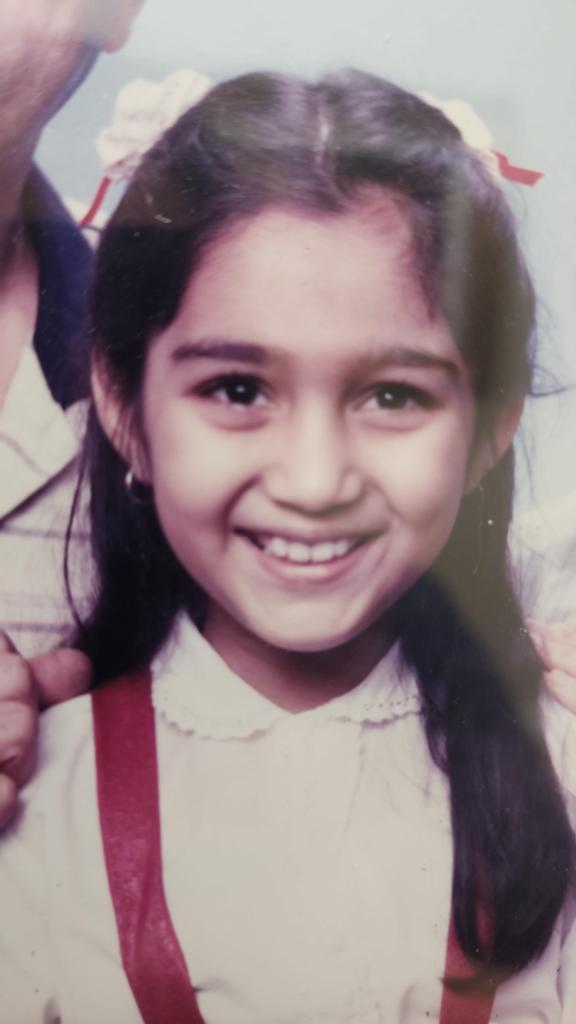
It’s been a joy wandering down memory lane with you all and reminding myself of many lessons that are still relevant today. As you reflect on things you could have taught or told yourself, how relevant are those lessons for you even now? I look forward to hearing your stories in the comments and through my social media.
Until next week!

 The Blind Hijabi
Leave a comment