The sun was shining brightly as I approached the school campus. Second period had ended, and one of my classmates noticed me casually descending from my mom’s metallic green Toyota van.
“Mariyam, you’re late again – but this time you missed both first and second period!” my classmate chided as I briskly walked across the parking lot.
“Yeah, I know,” I shrugged. “I had a religious thing this morning.”
Furrowing eyebrows, the classmate queried me further, “What religious thing? I thought Ramadan ended a couple months ago. Was it a special occasion?”
It was a random weekday in spring, and with Christmas and Hanukah long gone and Easter falling traditionally on a Sunday, my classmate seemed curiously perplexed. But having grown up around me eating strangely colorful food, politely refusing anything with pork, fasting for a month on what seemed to her a rotating and unpredictable schedule, and saying now and then how I was late because of some religious event that ran late the night before, my classmate knew me well enough to know that there really could have been some “religious thing.”
I grinned proudly, feeling very accomplished. “Oh yes! It’s Eid today, and I slaughtered a goat!”
Although not a vegetarian or vegan, my classmate expressed a mixture of confusion and horror. “Eid? You did what? Where did you slaughter a goat? Why?! And I thought Eid was over – after Ramadan?”
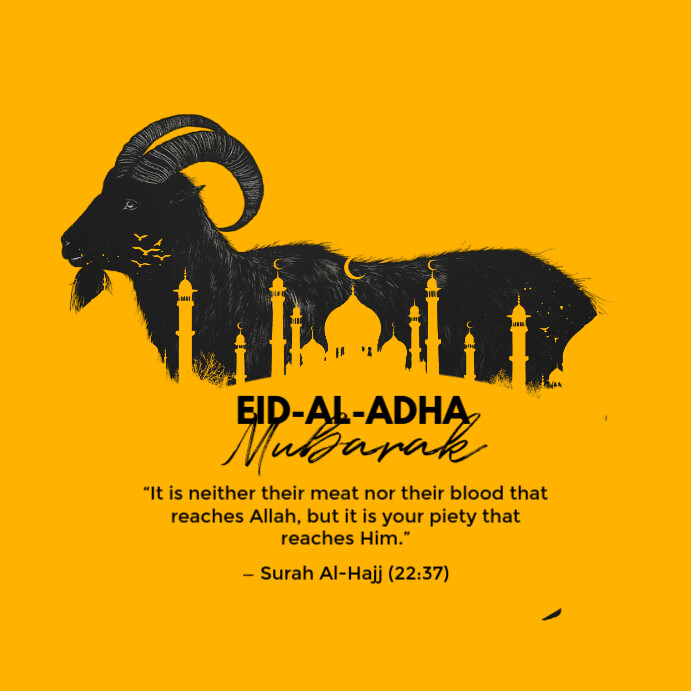
I explained it was another Eid – Eid-ul-Adha, when people celebrate the pilgrimage of Hajj, and during which they slaughter an animal like a goat, lamb, sheep, camel, or other “halal” mammal.
More questions tumbled out of my classmate, still trying to grapple with the concept of my casual description of my morning. Although I had done this more than a few times throughout my childhood and teenage years, feeling quite practiced in the experience, that morning was the first time I was getting to boast about how I – a young, Muslim girl – had slaughtered my own goat. My classmate was aghast.
I went on, highlighting how Eid-ul-Adha was quite Biblical and Abrahamic in nature, honoring the Prophet Abraham’s actual sacrifice of a lamb though he had been willing to sacrifice his son in obedience to God. I explained how Muslims perform a similar ritual during the Hajj, and even those of us who aren’t on the Hajj still go to slaughter an animal in accordance with a manner that is “permissible” – or “halal.”
“What does that mean?” my classmate inquired, lost.
I shared how Islam requires us to be humane to the animals we’re slaughtering. We’re not allowed to slaughter an animal that’s sick or pregnant for instance. We must give the animal water first. We recite the Quran as we’re performing the slaughter, use a very sharp knife and cut the animal’s throat so that death is as quick and painless as possible, and so that the blood drains easily from the animal, providing for cleaner meat.
“Mariyam, you’re telling me that you just came to school after using a very sharp knife to cut a goat’s throat?! You can’t see! How did you slaughter a goat?!”
“Well, I was holding the knife, and reciting ‘Bismillah’ – you know, that I begin with the name of God, and my dad was guiding my arm. But the force was all mine!”
“OMG! So did you do this inside a mosque?” My classmate’s imagination wandered from horrific to exotic, picturing some sort of temple ritual with an animal on a pedestal, everyone chanting and ready to dip their fingers into the animal’s flowing blood.
“No, of course not! We went to a farm,” I chuckled.
California’s central valley, where I spent my middle school and high school years, is replete with plenty of farmland. Somehow, members of my community – including my father – always managed to arrange a group discount deal with some local farm, gathering a bunch of folks from our religious community on Eid morning to slaughter our requisite goats, lamb, sheep, and occasionally even a cow! It was always memorable to see the community doctors always have the cleanest, quickest stroke; they were also often the fastest to finish the “zabiha” (or slaughtering).
As each animal was slaughtered, the farm owners would remove the fur and skin from the animal and hang the animal up to let the blood drain out. After we had long departed for school, work, or other errands (I always went to school unless Eid was on a weekend), the farm owners would turn over each family’s (or person’s) respective animal to some designated butcher shop – again exquisitely resourced by someone or other from the community where everyone would go by day’s end to get their nicely cleaned, cut, and packaged zabiha Halal meat.
Eid morning back then was a picnic-like community outing after a fatty breakfast of eggs (usually sunny side up), spicy and flavorful minced meat, hot “chai” of the Indian or Pakistani variety, biscuits, bread with butter and jams, and other fixings at the community center.
Even if folks privately dissed each other, or didn’t always get along (as is often the case in small communities where everyone knows everyone else and likes to know and judge their business), everyone stayed in a cheerful mood until departing from the farm, enthusiastically high-fived “Mubarak!” as each person completed their zabiha, and meant the congratulatory word with sincerity.
Sometimes, Eid evening became another community celebration, with all the meat now cleaned, fresh, and ready to barbeque or cook into something tantalizingly delicious.
Some years later, while we were still in high school, my classmate reminded me of our conversation, this time smiling broadly. “Mariyam, I’ll never forget the morning you came late and told me you had just slaughtered a goat! I couldn’t believe it! That was really something!”
When I look back at Eid celebrations during my childhood and teenage years, that morning remains the most memorable. On that particular morning, I realized how much religious culture and ritual I took for granted. But my ordinary religious experience had left an indelible mark on my classmate, and had probably defied stereotypes and notions in her head about animal slaughter, the meaning of “halal,” women in Islam, blindness, and likely more that we have yet to uncover.
As a veteran of three Hajj pilgrimages, here’s wishing everyone celebrating a very festive Eid-ul-Adha this week, and to those of you performing the Hajj, may you climb Arafa and be forgiven, and have a richly rewarding, blessed journey throughout until your safe return home!


 The Blind Hijabi
Leave a reply to Insiya Sevwala Cancel reply